What should you translate first?
You do not need to translate everything on day one. Rank content by what goes wrong if the guest misses it.
| Priority | Content | Why | Review level |
|---|---|---|---|
| 1 | Arrival, access, parking, checkout | Wrong understanding blocks the stay | Native reader check |
| 1 | Safety: pool, gas, fire, emergency numbers | Safety and liability | Native reader check |
| 2 | House rules | Avoid disputes and damage | Native reader check |
| 2 | Wi-Fi, TV, heating or cooling, appliances | Most repeat questions | Quick check |
| 3 | Local guide and tips | Adds value, low risk | Light check |
| 3 | Welcome note and thank-you | Tone matters | Quick check |
Review levels are general practice, not a standard. Raise the level for anything legal or safety-related.
How do you combine machine translation with human review?
Machine translation is fast and cheap but can choose the wrong word for an object or miss tone. Post-editing, the practice of having a person correct machine output, is a standard way to get speed without losing accuracy. Treat the first draft as a starting point, not a finished text.
- Write the source text in simple sentences, one idea per sentence, with the same term for the same thing (always "hob", never "stove" and "cooker").
- Generate a draft in each language with a translation tool or your panel's AI.
- Check names of objects (hob, boiler, router), numbers, times, codes and units first.
- Ask a native speaker to read the high-priority content, or a past guest who offered to help.
- Save the corrected version and note recurring errors so you can fix the source wording.
- Re-check whenever you change a rule or an appliance.
How should you handle guest messages in other languages?
Keep a few message templates in each language you serve: confirmation, directions, check-in day, checkout. For back-and-forth conversation, simple sentences translate best. Confirm key facts such as times and amounts in writing, and avoid idioms.
Booking platforms offer their own message translation; its behaviour varies by platform and account settings, so test how a message reads on both sides before relying on it.
- Greet in the guest's language, even if the rest is in English
- Use numbers and times in an unambiguous format (16:00, not 4 pm)
- Give the same phone number and message channel in every language
- Avoid humour and idioms that do not translate
What about signage inside the property?
Label things that cannot be searched: switches, the fuse box, the gas shutoff, the pool gate. Use icons plus short text in two or three languages, and pictures wherever possible. Keep physical signs for safety and emergency numbers; put everything that changes (rules, local tips, Wi-Fi) on a screen you can update.
How does Welcomo serve guests in their language?
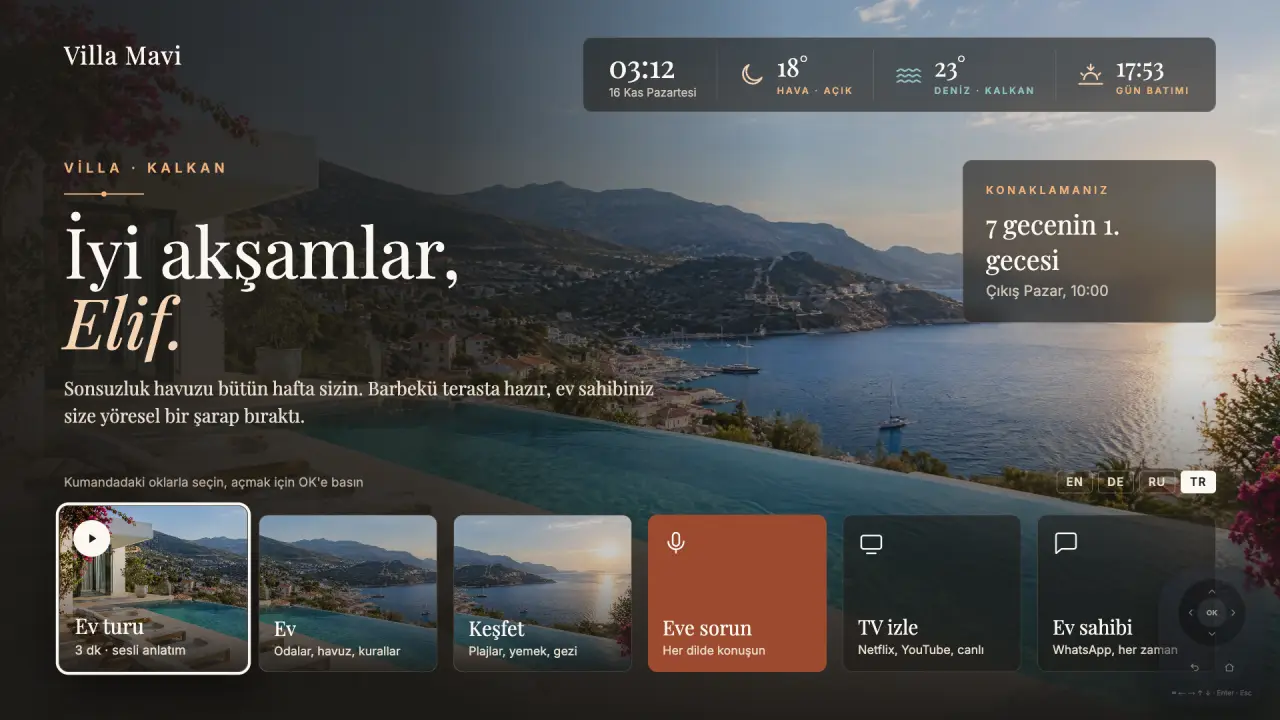
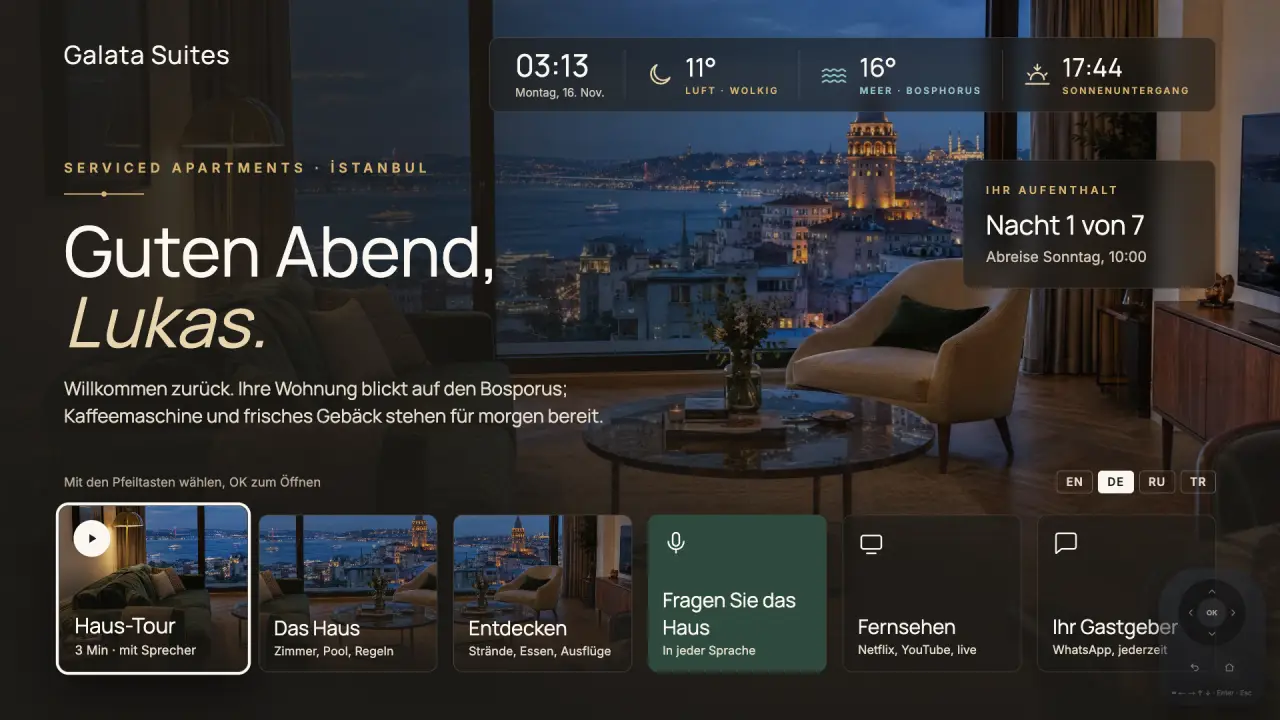
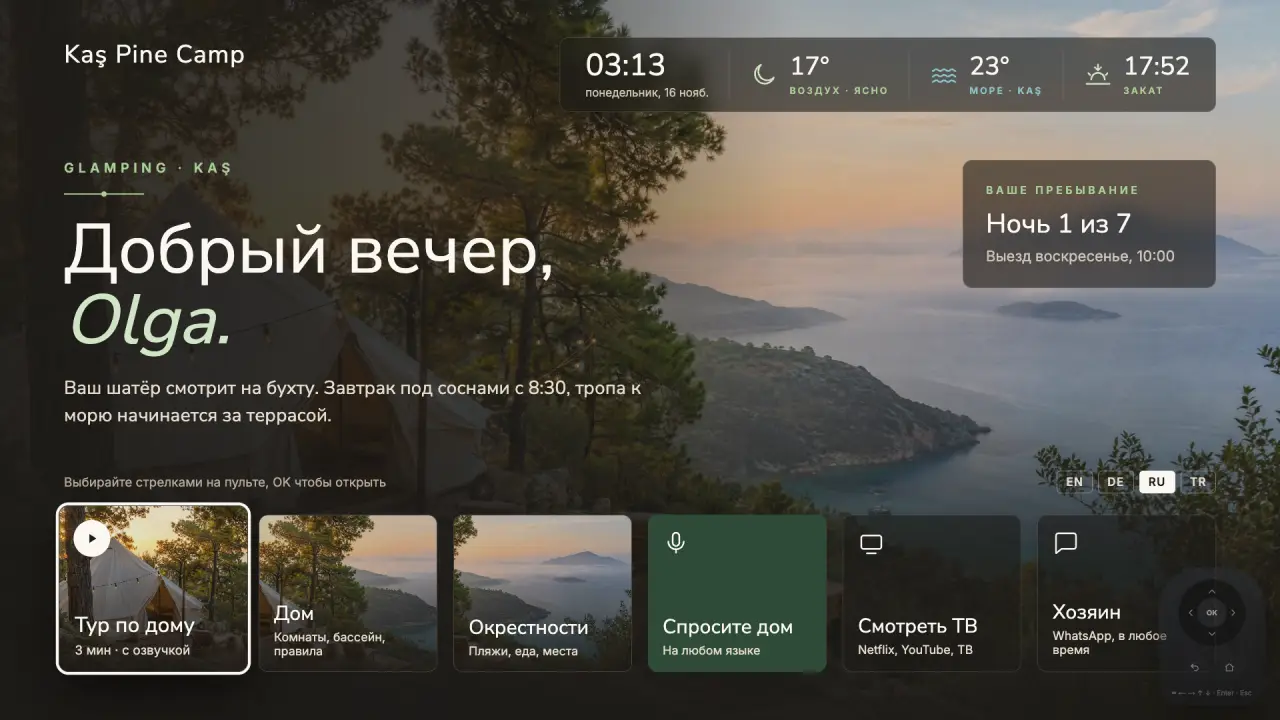
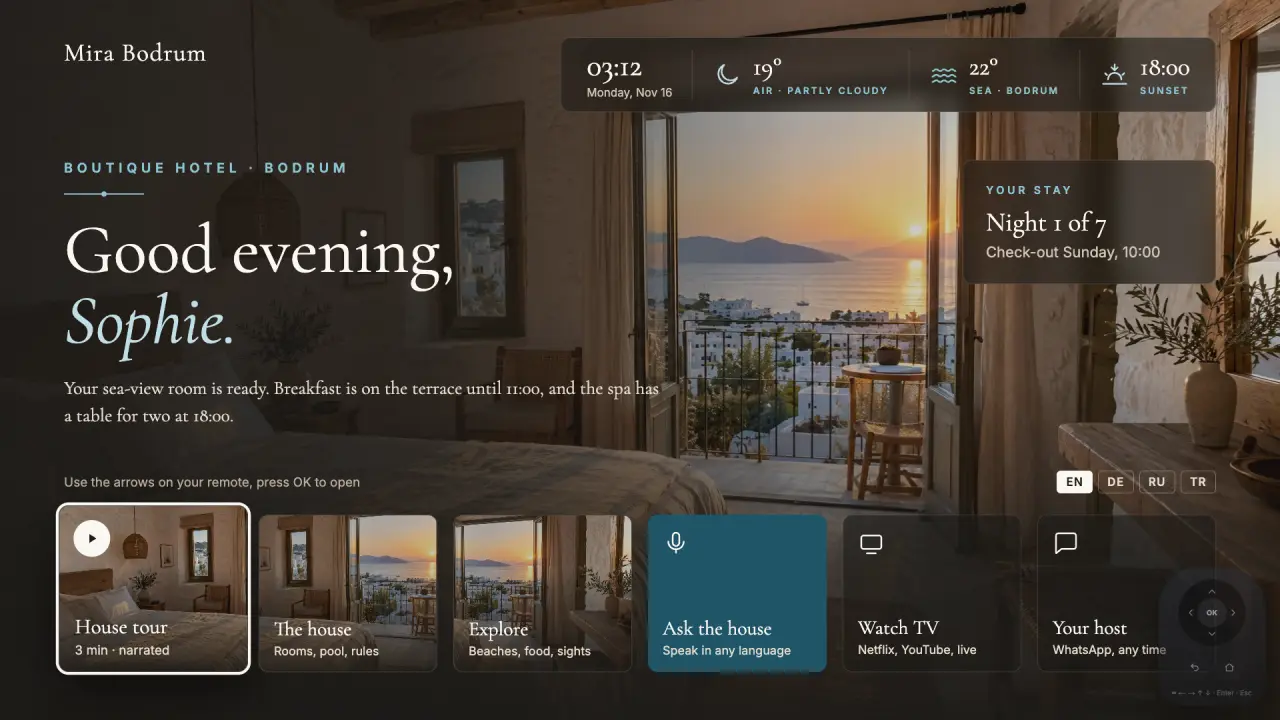
In Welcomo, the TV greets the guest by name and in their language, and the language follows the guest's booking data with a manual switch available. House info, rules, the local guide and the assistant follow that language, and the private phone page that opens by QR code (active from booking to check-out) uses it too. Languages are Turkish, English, German and Russian.
You manage this in one panel: write once in your own language, and the AI drafts the other languages for you to review and edit. The AI assistant answers from your own information and forwards what it cannot answer to you, so you still handle real exceptions. Bookings arrive by iCal or API so the language and guest name come with the reservation. For rules and safety wording, do a human review in each language.
What if a guest speaks a language you do not offer?
Welcomo covers four languages today. For guests who speak something else, fall back to simple English and rely on pictures, icons and a short phrase list. Keep your emergency details visible in the most widely understood language and offer a direct phone number.
What does a short message template look like in each language?
Keep a small set of templates and have each one checked once. These examples are deliberately simple so they translate well. Replace the brackets.
| Language | Greeting |
|---|---|
| English | Hello [name], welcome! Check-in is from 16:00. The door code is [code]. Wi-Fi is on the TV. Call [phone] if you need anything. |
| Turkish | Merhaba [name], hoş geldiniz! Giriş saat 16:00'dan itibaren. Kapı kodu [code]. Wi-Fi televizyonda yazılı. Bir şey gerekirse [phone] numarasını arayın. |
| German | Hallo [name], willkommen! Check-in ab 16:00 Uhr. Der Türcode ist [code]. Das WLAN steht auf dem Fernseher. Bei Fragen rufen Sie [phone] an. |
| Russian | Здравствуйте, [name], добро пожаловать! Заселение с 16:00. Код двери: [code]. Wi-Fi указан на телевизоре. Если нужна помощь, позвоните: [phone]. |
Have a fluent reader check these before use. Short, plain sentences are easier to translate and to review.
What does one item look like on a card, the phone and the TV?
Take the house rule about quiet hours. A printed bilingual card at the entrance carries the rule in two languages with a small icon. The guest's phone page shows the rule in the guest's own language with one line of reason. The TV welcome screen shows it in the same language alongside the greeting. With Welcomo the language comes from the booking, and the guest can switch manually, so a German family and a Russian couple in the same villa in different weeks see their own version without you changing anything between stays.
What about names, mixed groups and mistakes?
Real guests do not fit one language. A booking may be made by someone who speaks English for a group that speaks Turkish. Expect these cases and decide in advance how to handle them.
- Mixed groups: choose the language of the person who will use the screen, and make the switch easy to find
- Names: write guest names exactly as given, including characters outside the Latin alphabet where your system supports it
- Dates, times and units: use unambiguous formats, such as 16:00 and 24 November, and metric units
- Currency and tipping: state them where relevant, since customs differ
- Translation errors: when a guest points one out, fix the source wording once so every language improves
- Right to left and other scripts: check the layout if you ever add them
What are the common mistakes?
These are the mistakes that make a translated guide worse than none.
- Translating word for word without checking object names such as hob, boiler or router
- Using humour and idioms in the source text
- Leaving some parts in one language and some in another, so the guide feels unfinished
- Translating the listing but not the check-in instructions or the safety notes
- Letting translations drift out of date after the source is changed
- Using a long, complicated source text that translates poorly
- Assuming everyone speaks English as a second language
How do you keep every language up to date?
The hardest part of a multilingual guide is not the first translation, it is the tenth edit. Change the source text in one place, and regenerate the other languages from it, rather than editing each language separately. Keep a short list of terms (hob, boiler, router, lockbox) with their agreed translations so the same word is used each time.
When something changes, such as a new Wi-Fi password or a closed restaurant, update the source first and review the new versions of the high-priority items. In Welcomo this is one edit in the panel, with the AI drafting the other languages for you to approve, so the TV and the phone page never disagree with each other.
Frequently asked
Is machine translation good enough for vacation rental guests?
For a first draft, yes. For safety, rules and legal wording, have a fluent reader check it. Errors tend to appear in object names and tone.
Which languages should I offer?
Start with the languages your last guests used and your main markets. Welcomo currently offers Turkish, English, German and Russian.
Do I have to write everything four times in Welcomo?
No. You write once in one language and the AI drafts the others, which you review and edit in the panel.
Should I put translations on the listing too?
Where your platform supports it, yes. At minimum make sure the title, key amenities and rules are clear in the language of your largest guest group.