What is the quickest way to make one?
Open the free Wi-Fi QR code tool at /en/airbnb-wifi-qr-code, type the network name and password, choose the security type and download the image. Everything runs in your browser. Then print it, save it into your house manual and, if you use Welcomo, show it on the TV.
If you prefer to understand the format or build the text yourself, read on.
What is the Wi-Fi QR code format?
The ZXing project, whose barcode formats many scanner apps follow, documents the Wi-Fi network config as WIFI: followed by semicolon-separated key and value pairs, ending with two semicolons. The order of the fields does not matter. The simplest example is WIFI:T:WPA;S:mynetwork;P:mypass;;
| Field | Meaning | Notes |
|---|---|---|
| T | Security type | WPA for a password network (the documented values are WEP, WPA and WPA2-EAP), or nopass for an open network. Leaving T out also means no password |
| S | Network name (SSID) | Required |
| P | Password | Ignored when T is nopass, so it can be left out |
| H | Hidden network | Optional. Set to true if the SSID is hidden |
Format as documented in the ZXing wiki, Barcode Contents, retrieved 2026-11-16.
How do you escape special characters?
The characters backslash, semicolon, comma, double quote and colon must each be preceded by a backslash, because they would otherwise be read as part of the format. The ZXing documentation gives this rule, as in MECARD encoding.
It also says that if a name or password is plain text that could be mistaken for a hexadecimal string, for example ABCD, you should wrap it in double quotes. Our tool handles both rules for you.
| Network and password | Text inside the QR code |
|---|---|
| Network VillaMavi, password sea2026 | WIFI:T:WPA;S:VillaMavi;P:sea2026;; |
| Network Villa Mavi Guest, password open sesame | WIFI:T:WPA;S:Villa Mavi Guest;P:open sesame;; |
| Network Café;Guest, password ab;c | WIFI:T:WPA;S:Café\;Guest;P:ab\;c;; |
| Open network GuestOpen with no password | WIFI:T:nopass;S:GuestOpen;; |
| Hidden network Cellar, password x1y2 | WIFI:T:WPA;S:Cellar;P:x1y2;H:true;; |
Should the network be WPA or open?
Use a password network. An open network lets anyone in range join, including neighbours and passers-by, and unencrypted traffic can be observed. If you choose a password network, T:WPA is the value used in the documented format. An open network uses T:nopass and no password field.
A QR code lowers the effort of a long, secure password, so you can use a strong one without annoying guests. Pick a password that is easy to read aloud in case a guest cannot scan, and avoid characters that look alike such as zero and the letter O.
Will guests' phones read it?
Hosts use Wi-Fi QR codes because guests ask for the password first and a scan avoids typing it. Not every guest will scan, though; older guests and some international visitors may prefer to type. Test the code yourself on at least one iPhone and one Android phone using the normal camera before you print it, and leave the network name and password in plain text next to the code as a fallback.
How should you print and place it?
A code that does not scan is worse than no code, so treat print quality as part of the job.
- Print at least 3 by 3 centimetres; larger is better for a code on a wall
- Dark code on a light background; do not invert the colours or lower the contrast
- Leave a blank margin around the code
- Avoid a glossy surface behind glass where reflections can break scanning
- Write the network name and password in plain text beside the code
- Laminate or use a card that survives spills
- Place one on the fridge or kitchen counter, one in the living area and one in each bedroom if the signal differs
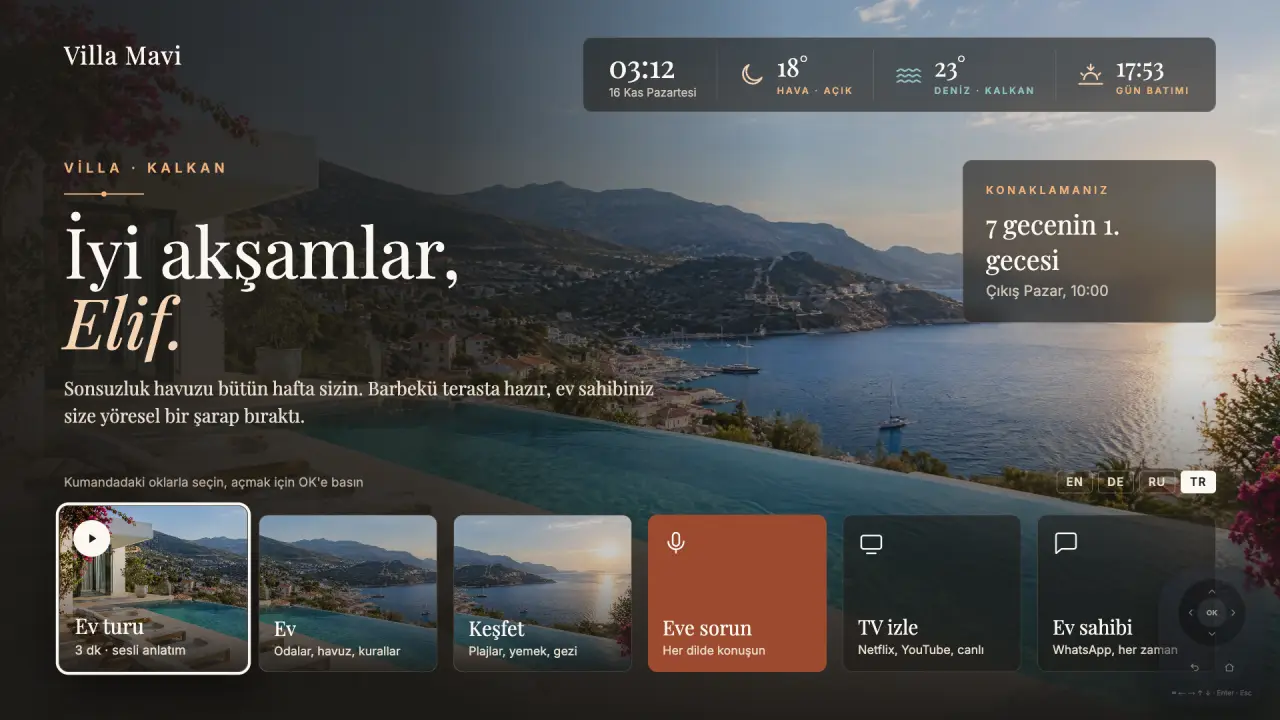
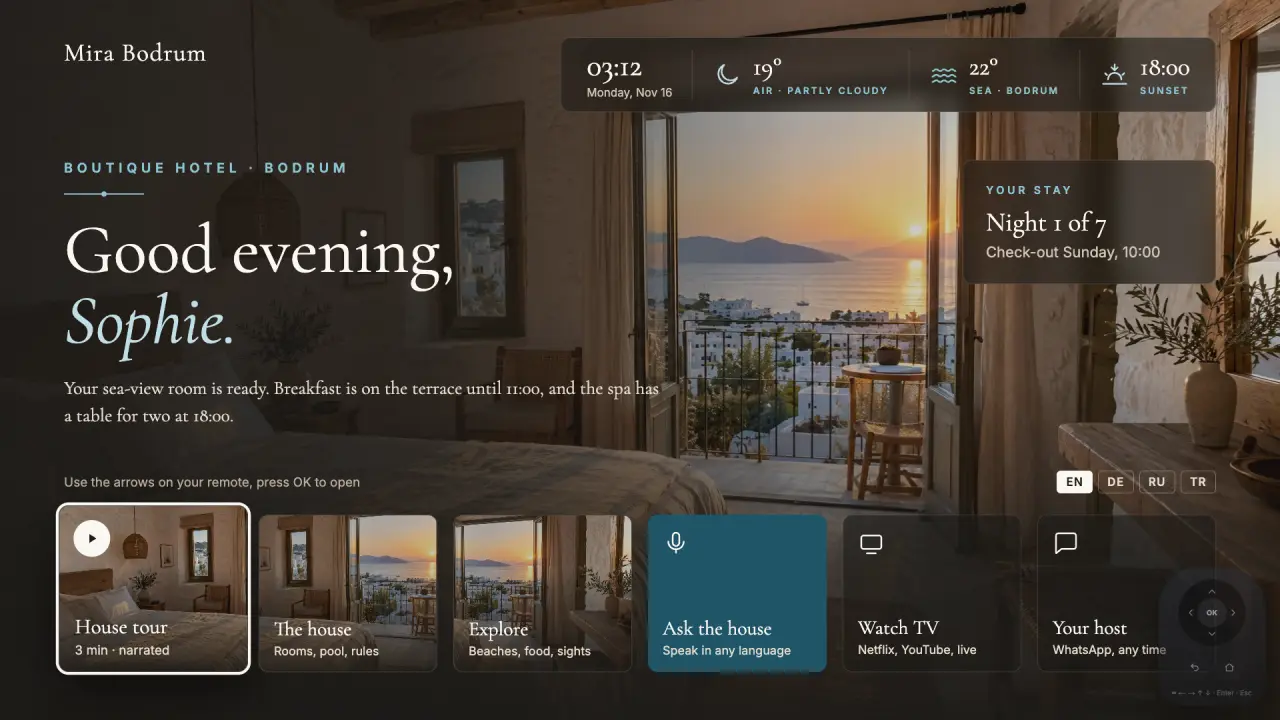
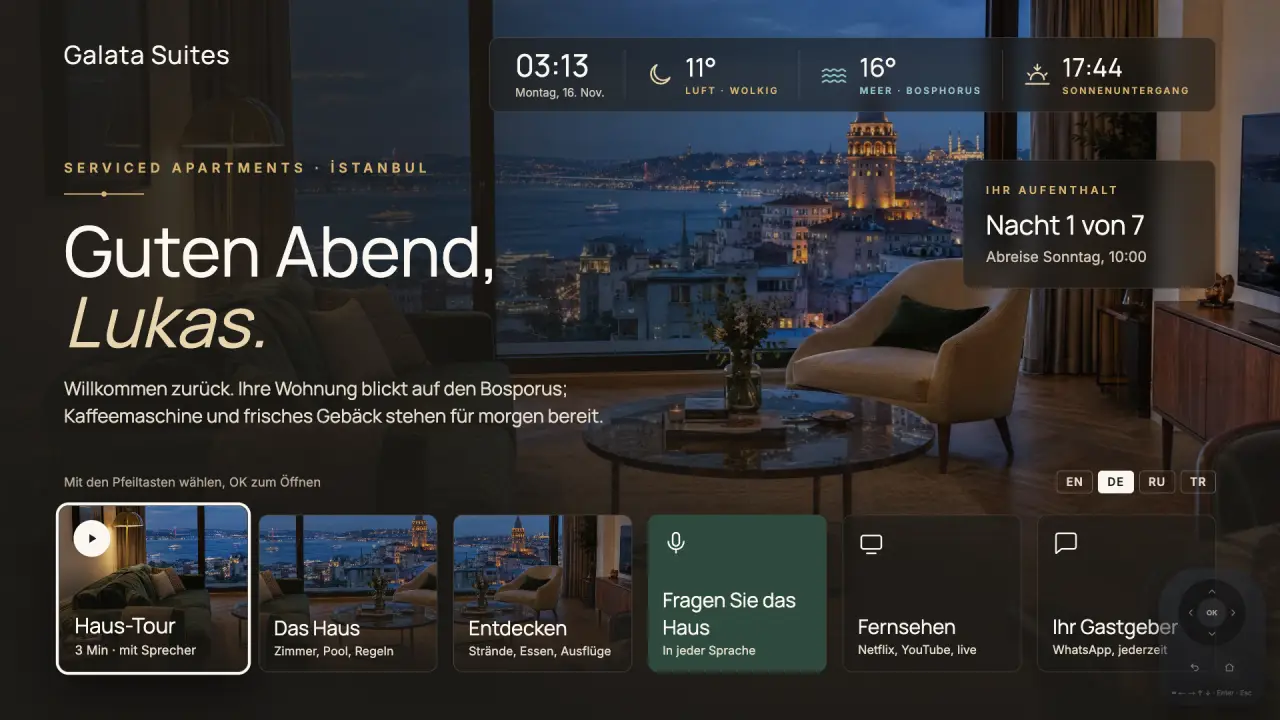
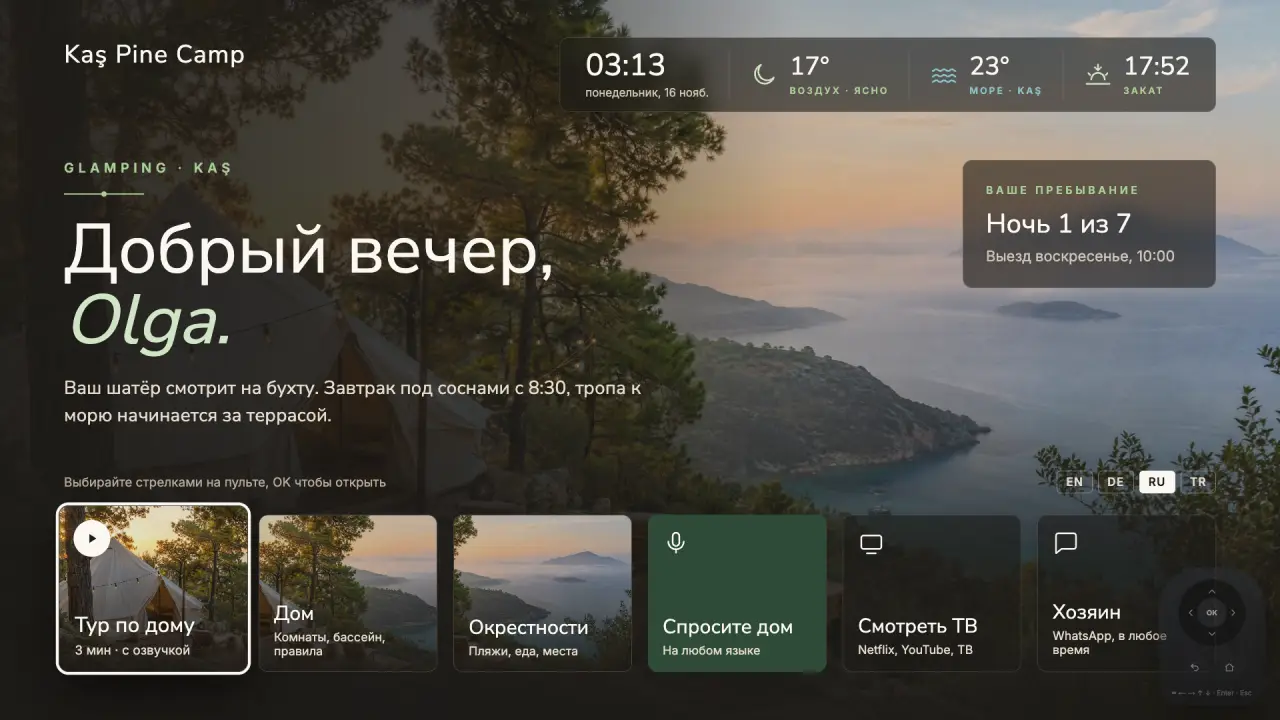
- Add it to the house manual and, with Welcomo, to the TV screen so it is on display from the first minute
How do you keep your own network safe?
Set up a separate guest network for visitors, so your own computers, cameras and smart-home equipment stay on another network. Most home routers have a guest network option. Give it a different name and password from your main network.
Change the guest password from time to time, and regenerate the QR code whenever you do. If a guest leaves with the old code, they should no longer be able to join. Keep a record of when you changed it, and update the code everywhere it appears: the printed card, the manual and the TV.
What if the code does not scan?
Work through these checks in order.
- Check the text. A missing double semicolon at the end, or an unescaped special character in the name or password, is the most common cause.
- Check the security type. A password network needs T:WPA; an open network needs T:nopass.
- Check the size and contrast of the print, and make sure there is no glare or fold across the code.
- Check the password in plain text by joining manually. If that fails too, the password is wrong, not the code.
- Check for a hidden network. If the SSID is hidden, the code must include H:true.
- Try another phone. If one phone fails and another works, leave the plain text fallback in place.
Frequently asked
Is the Wi-Fi QR code tool free?
Yes. The tool at /en/airbnb-wifi-qr-code is free, runs in your browser and does not store your network name or password.
Does it work for an open network?
Yes. Set the type to nopass and leave the password empty. We still recommend a password network.
Do I need a new code when I change the password?
Yes. The password is inside the code, so a new password needs a new code. Replace every printed copy.
Is it safe to put the password in a QR code?
The code holds the same information as the written password, so anyone who sees the code can join. That is why you should use a separate guest network and change the password periodically.
Can I show it on the TV?
Yes. The Welcomo welcome screen shows the Wi-Fi QR code on the TV, and when the password changes you update it once in the panel.
Sources
- ZXing wiki: Barcode Contents (Wi-Fi network config) · retrieved November 16, 2026