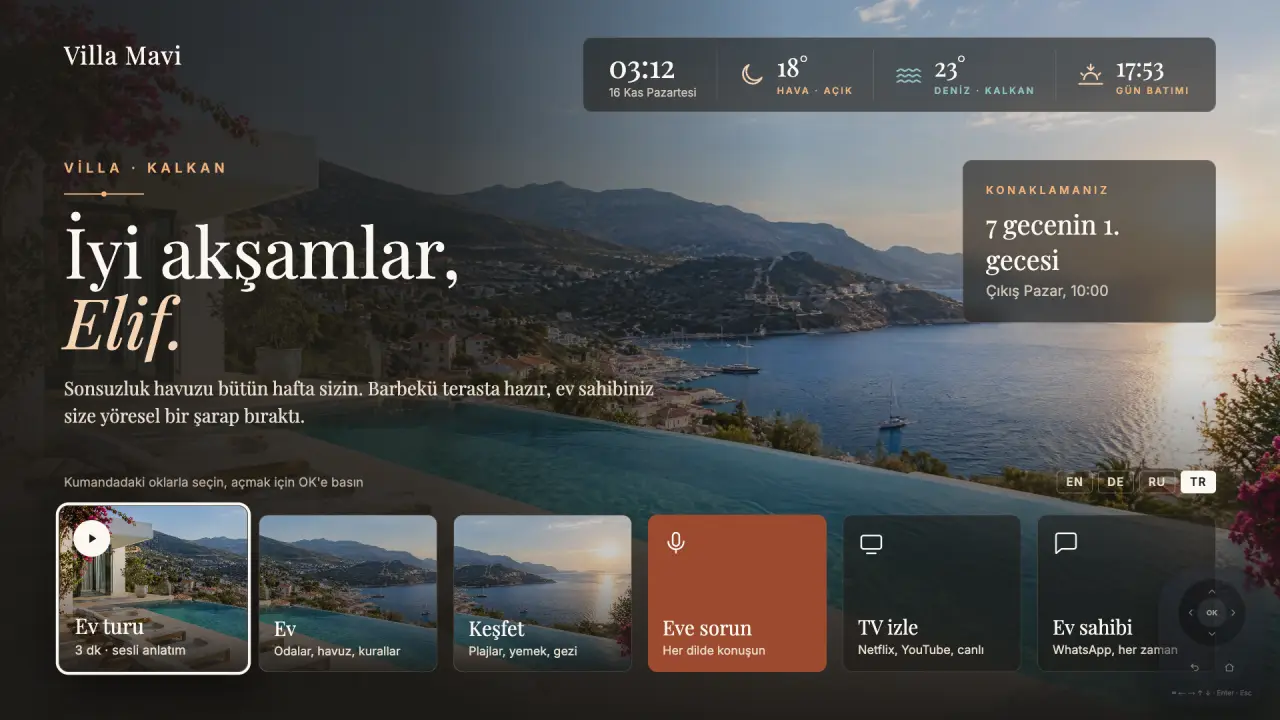
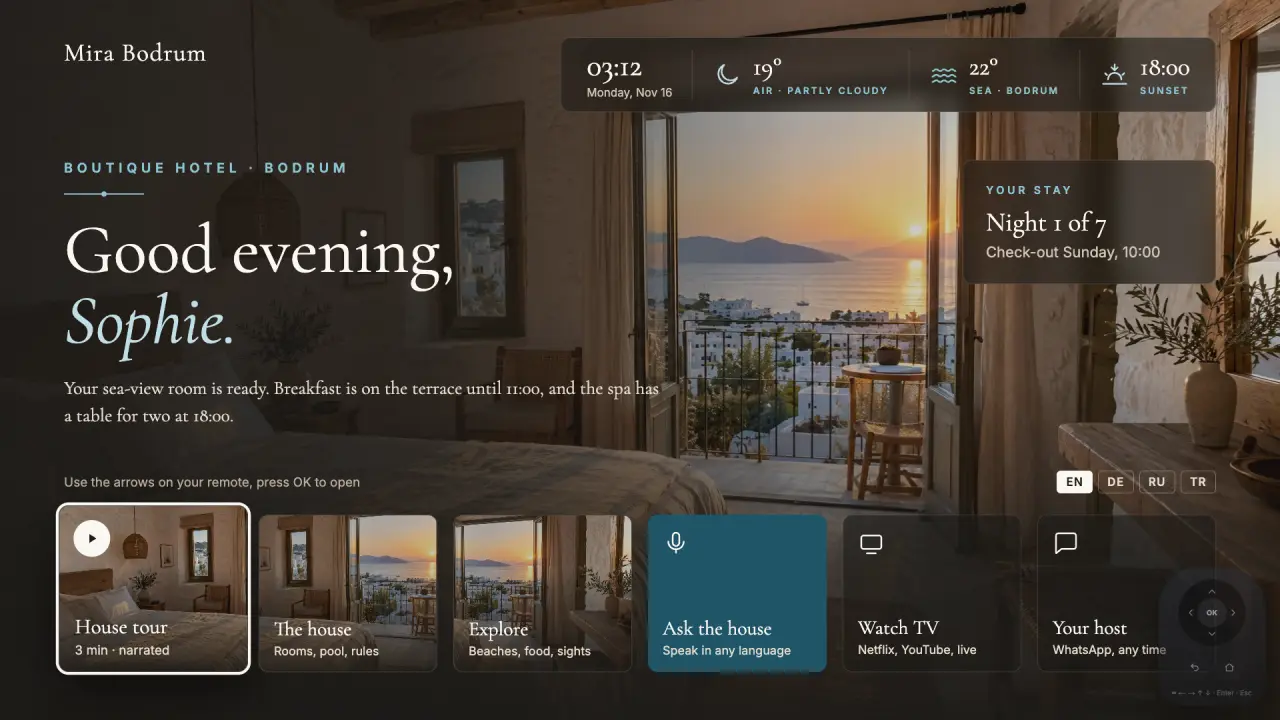
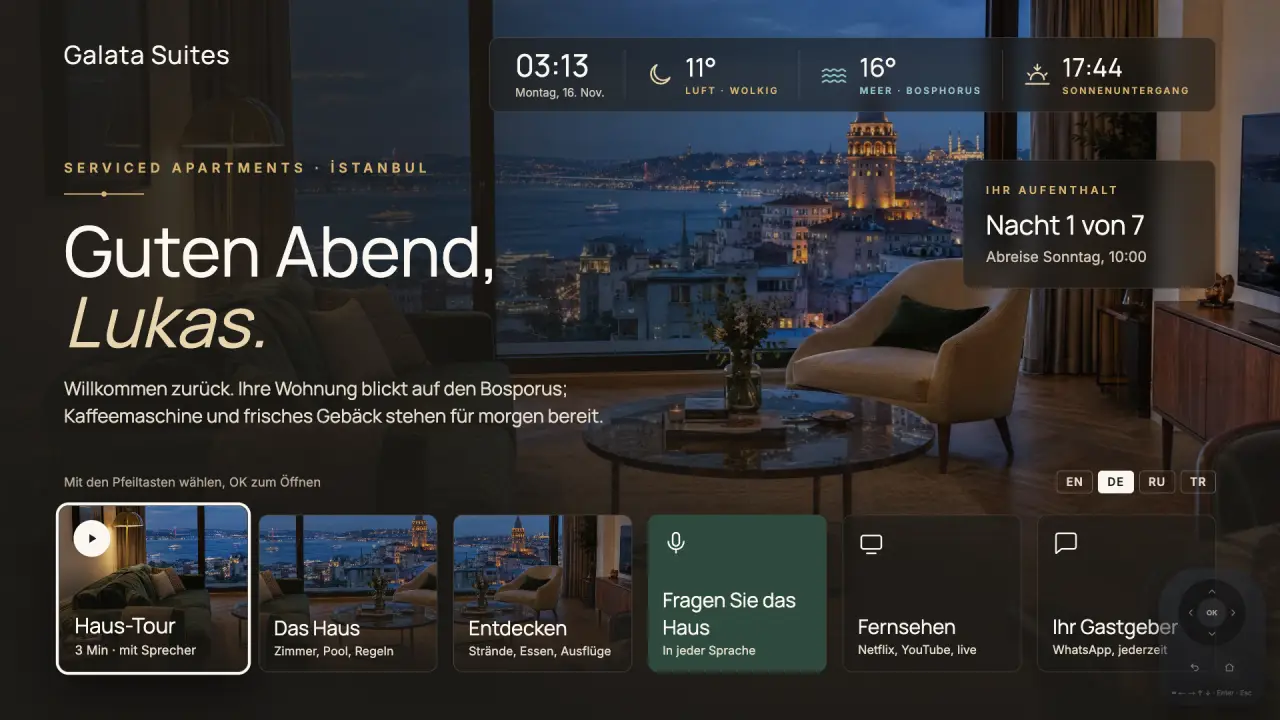
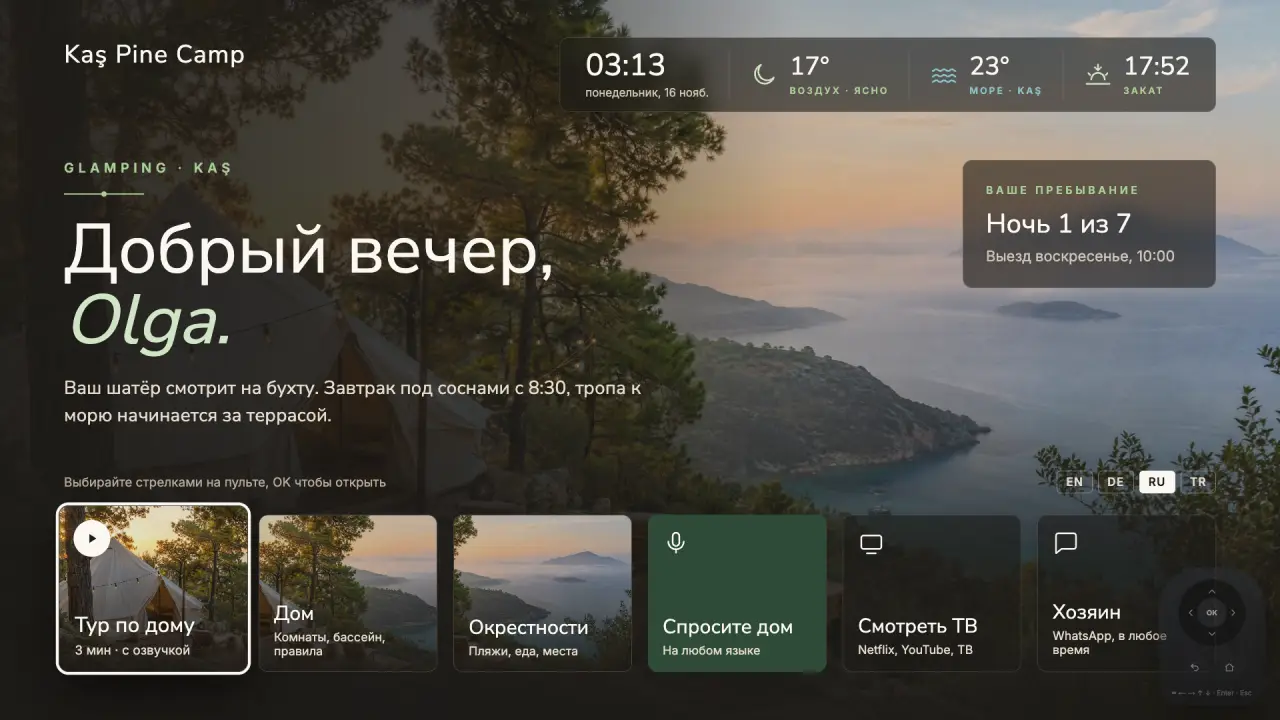
What should a welcome book cover in the first hour?
Guests open the book (or scan the QR code) when something is blocking them: a door, a password, a switch. Put these at the very top, each on its own line with the answer in the first words.
- A warm one-line greeting using the guest's name, plus how to reach you
- Exact address and a pin or landmark for the last 200 metres
- Parking: where, how many cars, anything unusual about the road
- Door or lock instructions, with a fallback if the code fails
- Wi-Fi name and password (a QR code is faster than typing)
- How to turn on the TV and which input or app to use
- Heating or air conditioning: which remote, which mode, what to avoid
- Hot water: how long it takes, any switch to flip
Which ideas help during the stay?
These are the items that otherwise become messages at 9 pm. Write each one the way you would explain it standing next to the guest.
- Kitchen: hob, oven, coffee machine, dishwasher, where the spare gas or filters are
- Laundry: washer and dryer instructions, drying rack, detergent
- Pool, garden, barbecue or hot tub: opening hours, safety, towels, cleaning expectations
- Bins and recycling: where, which day, which colour
- What is provided (toiletries, linen, beach towels) and what to bring
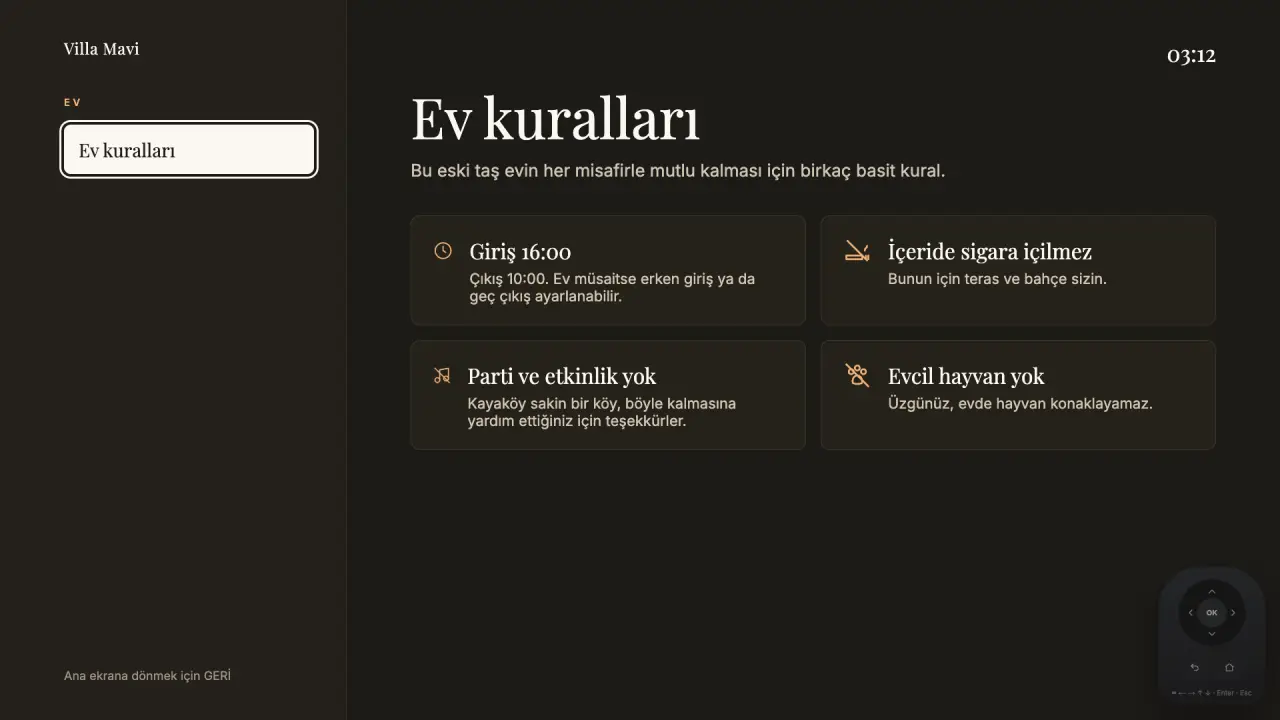
- Quiet hours, smoking, pets, parties: friendly wording, not a list of threats
- Safety: smoke alarm, extinguisher, first aid kit, gas shutoff
- Emergency numbers, nearest pharmacy and hospital, and when to call you instead
How do you write local recommendations that feel personal?
Generic top-ten lists are what guests can already find online. What they cannot find is your opinion. Give fewer places, with a reason and a tip for each.
- Breakfast: the bakery you go to, and the time it sells out
- Dinner: one easy place, one special-occasion place, one that takes children without fuss
- Beach or nature: best time of day, what to bring, where to park
- A rainy-day idea and an early-morning idea
- Groceries and pharmacy, with opening hours
- One thing you would tell a close friend that is not in any guidebook
Printed binder, PDF, guidebook or TV: which format for which content?
No single format does everything well. Match each type of information to where the guest is when they need it.
| Content | Printed binder | Link or PDF | TV in the living room | Phone page via QR |
|---|---|---|---|---|
| Wi-Fi and TV basics | Fine, but gets outdated | Good | Best: guest is already in front of it | Good |
| House rules | Good | Good | Good: seen on arrival | Good |
| Appliance instructions | Good next to the appliance | Good | Fine | Best when you are standing at the oven |
| Local tips | Gets outdated | Good | Good for browsing together | Best on the go |
| Emergency numbers | Good (works offline) | Fine | Fine | Good |
| Questions you did not cover | No | No | Assistant answers | Assistant answers |
A short printed sheet for emergencies and the Wi-Fi is still worth keeping, because power and internet can fail.
What example wording works?
Short sentences, specific numbers, no apologies. Here are lines you can adapt.
- Wi-Fi: "Network: VillaMavi. Password: sunset2026. The router is on the shelf above the TV; if the internet stops, unplug it for ten seconds."
- Quiet hours: "We ask for quiet after 22:00 because the neighbours are close. The terrace is lovely at night, just keep voices low."
- Checkout: "Checkout is at 10:00. Please close the windows, turn off the air conditioning and leave used towels in the bath. No need to wash up or strip beds."
- Problem: "If something is not working, message us first. We usually reply within the hour and can often fix it by phone."
What should you cut?
Length is the usual failure. A forty-page binder is read by nobody. Remove anything the guest cannot act on, repeated rules, a history of the house, and long paragraphs of warnings.
Airbnb's own advice on house rules is to keep additional rules reasonable, and it gives examples such as asking guests to put used dishes in the sink rather than wash and put them away. The same logic applies to a welcome book: ask for what is easy, and say why.
How do you keep the book current and in the guest's language?
The weak point of any printed book is that it ages: the Wi-Fi password changes, a restaurant closes, the gas bottle moves. It is also in one language, usually yours.
Welcomo keeps this content in one panel and shows it in several places: on the TV in the living room (with the guest's name and language), on the guest's private phone page opened by QR code (active from booking until check-out), and through an AI assistant that answers from your own information and passes anything it cannot answer to you. You write once in one language and the AI drafts the other languages (Turkish, English, German, Russian) for you to review. A printed one-page backup remains a good idea.
How does the same content look on a printed card, the phone and the TV?
Take one item, the Wi-Fi, and see how it changes by format. The content is identical; the shape follows where the guest is standing.
| Format | How the Wi-Fi entry looks | Why it works there |
|---|---|---|
| Printed card on the kitchen counter | Network name and password in large type, router location, one line on what to do if it stops | Works with no power or internet, and is the backup when everything else fails |
| Phone page opened by QR | Network name, a tap-to-copy password, and a short note on the router | The guest is often away from the TV, and copying a password is easier than typing it |
| TV welcome screen | A QR code the guest scans to join, shown next to the greeting | It is the first screen the guest sees, so no search is needed |
Which special situations should the book mention?
The ordinary pages are easy. Add a short entry for the situations that otherwise cost you a call at an awkward hour.
- Late arrival: where the keys are and who to call after a certain time
- Lost key or lockout: the first thing to try, then who to ring
- Power cut or no hot water: where the fuse box and the boiler switch are
- Noise from the street or neighbours: what is normal and who to tell
- Children and babies: where the cot, high chair and gates are, and the pool and stairs safety notes
- Accessibility: steps, door widths, bathroom layout, so guests can judge before they need to ask
- Rain, heat or cold: what to do indoors, how to use shutters, awnings and heating
- Extended stays: laundry, mid-stay cleaning and where to buy extra supplies
What are the common mistakes?
Most welcome books fail in the same few ways. Check yours against this list.
- Starting with the history of the house instead of the Wi-Fi and the door
- Writing in paragraphs when a guest needs a line and a number
- Leaving out photos of the things guests have to find: fuse box, hot water switch, bin store
- Letting information go stale after a router, appliance or restaurant changes
- Putting rules in a harsh tone, so the first page reads as a list of prohibitions
- Offering the book in only one language
- Not telling guests the book exists: mention it in the pre-arrival message and put a card or QR code where they land
What is the quickest way to start?
Do not write twenty pages. Open your last twenty guest conversations, list the questions that appear more than once, and write a short answer to each. Add arrival, Wi-Fi, checkout and emergency numbers. That one page is already better than most binders. Then grow it a section at a time as new questions come in, so the book reflects what guests really ask, not what you imagine they will.
Frequently asked
How long should an Airbnb welcome book be?
As short as the property allows. Guests scan rather than read, so put arrival, Wi-Fi and checkout first and keep each section to a few lines. If it needs more than a handful of pages, split the extras into a separate local guide.
Is a welcome book the same as an Airbnb guidebook?
No. Airbnb describes a guidebook as a set of local recommendations, separate from a house manual that explains how your home's features work. A welcome book usually combines the house manual with your own local tips.
Should the welcome book be printed or digital?
Both work, for different jobs. Print the emergency numbers and Wi-Fi as a one-page backup. Put everything else where it can be updated and translated, such as a link, a TV screen or a phone page.
What do guests ask most often that a welcome book should answer?
In general practice it is Wi-Fi, how to get in, parking, heating or cooling, TV use and checkout. Answering these clearly removes most repeat messages.
Sources
- Airbnb Help Center: What's a guidebook? · retrieved November 16, 2026
- Airbnb: Setting and creating helpful house rules · retrieved November 16, 2026