What is an AI concierge in a vacation rental?
Vendors describe an AI concierge as AI-powered software that messages guests through chat to answer questions and handle routine requests around the clock. Hostaway's glossary lists check-in, check-out, Wi-Fi passwords, parking, appliances, house rules, amenities and local recommendations as the usual topics, and says anything needing judgment, such as refunds or special arrangements, is usually escalated to a human.
In practice it is a chat box attached to something the guest already opens: a digital guidebook, a messaging inbox, a phone page, or a TV screen. It does not replace the host. It absorbs the repetitive questions so the host only sees the ones that need a person.
It is not the same as a general chatbot. A general chatbot answers from everything it has ever read. A property concierge is supposed to answer about this house: this Wi-Fi name, this parking spot, this boiler.
What can an AI concierge do, and what can it not?
It is strong where the answer already exists in writing and does not change from guest to guest. It is weak wherever the answer depends on judgment, on live conditions, or on something nobody wrote down.
| Question type | Good fit? | Why |
|---|---|---|
| Wi-Fi name and password, check-out time, bin day | Yes | Fixed facts in your house information |
| How do I turn on the hot tub, oven or heating? | Yes, if you wrote it | Quality depends on how complete your instructions are |
| Where is a good dinner nearby? | Yes, if you list places | Best when limited to your own recommendations |
| Can we check out late? Can we bring a dog? | Hand to host | Needs your decision, may cost money |
| The water is not working | Hand to host, fast | Needs a person and urgency |
| Refund or compensation | Hand to host | Judgment and money |
| Is the ferry running today? | Not from static info | Live information it does not have |
Tourmie's help page says its assistant answers from the content you add to your properties and guides, and that it performs best with complete, accurate guide information.
Why should answers come from your own information, not the open web?
A language model that answers from general knowledge will sometimes produce a confident answer that is simply wrong, such as inventing a door code, a pool opening time or a restaurant that closed. The usual remedy is retrieval: the system first looks up relevant text from a trusted source and answers from that. AWS describes retrieval-augmented generation as having the model reference an authoritative knowledge base outside its training data, and lists presenting false information when it does not have the answer as one of the problems this addresses.
For a rental, the trusted source is your own house information: rules, instructions, local recommendations. Two practical consequences follow. First, the assistant can only be as accurate as what you wrote, so outdated instructions produce outdated answers. Second, a well-built assistant should say it does not know when the information is missing, instead of improvising. Tourmie's documentation describes exactly this behaviour: the assistant tells the guest it does not have the answer and suggests contacting the host.
Open-web answers have a place for general local knowledge, but they carry two risks for a host: the information may be wrong for your specific property, and you cannot review what was said. If you allow web answers at all, keep them clearly separate from house rules and safety information.
How does forwarding to the host reduce the risk?
Grounding lowers the chance of a wrong answer. Forwarding handles the questions grounding cannot answer. When the assistant finds nothing relevant in the property's information, the safe move is to stop, tell the guest honestly, and pass the question to the host with the guest's wording intact.
This turns the failure mode from a wrong answer into a short delay. It also gives you a to-do list: every forwarded question points at a gap in your house information. Add the answer once and the next guest gets it instantly.
Welcomo's assistant is built this way. It answers only from the property's own information and forwards what it cannot answer to the host. That does not make it infallible, so test it with real questions before guests arrive, as described in the checklist below.
How do languages work?
International guests are the main reason hosts adopt these tools. Some products let you set a fixed reply language or auto-detect the guest's language. Tourmie, for example, offers both settings. The practical question is where the source text lives: if your house information is written in one language and the assistant answers in another, check that translations of instructions keep their meaning, especially for safety items.
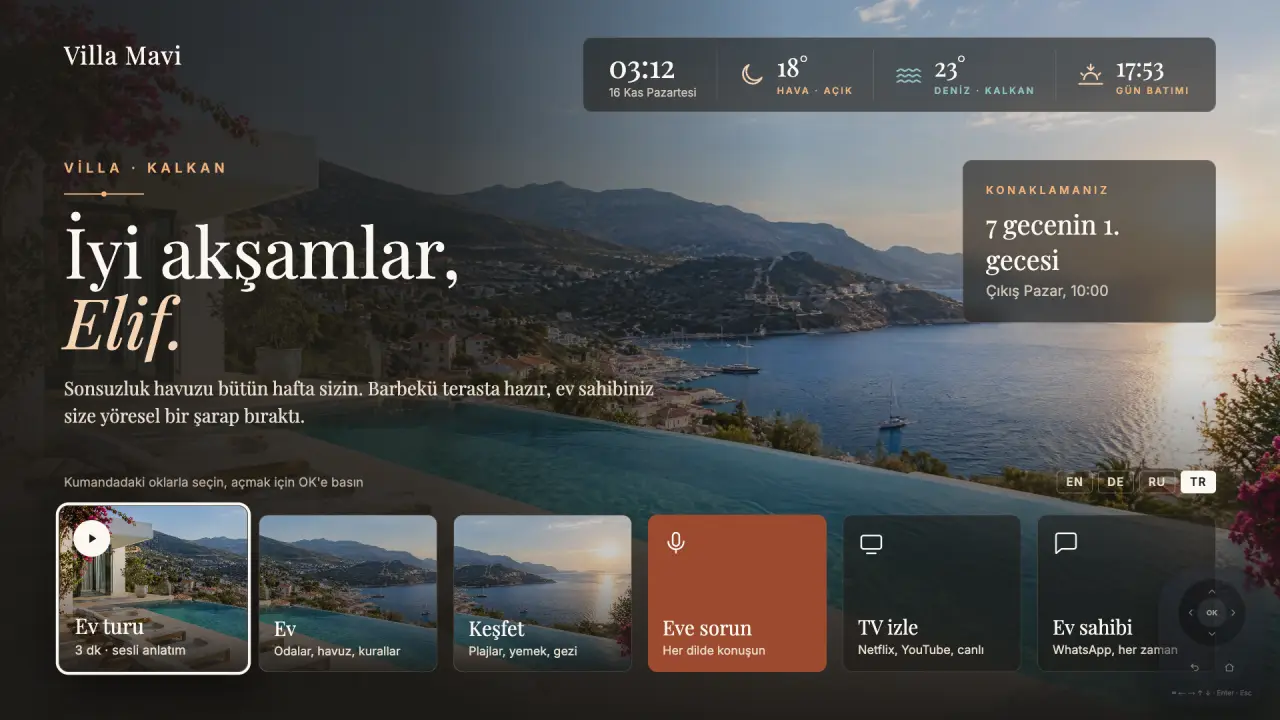
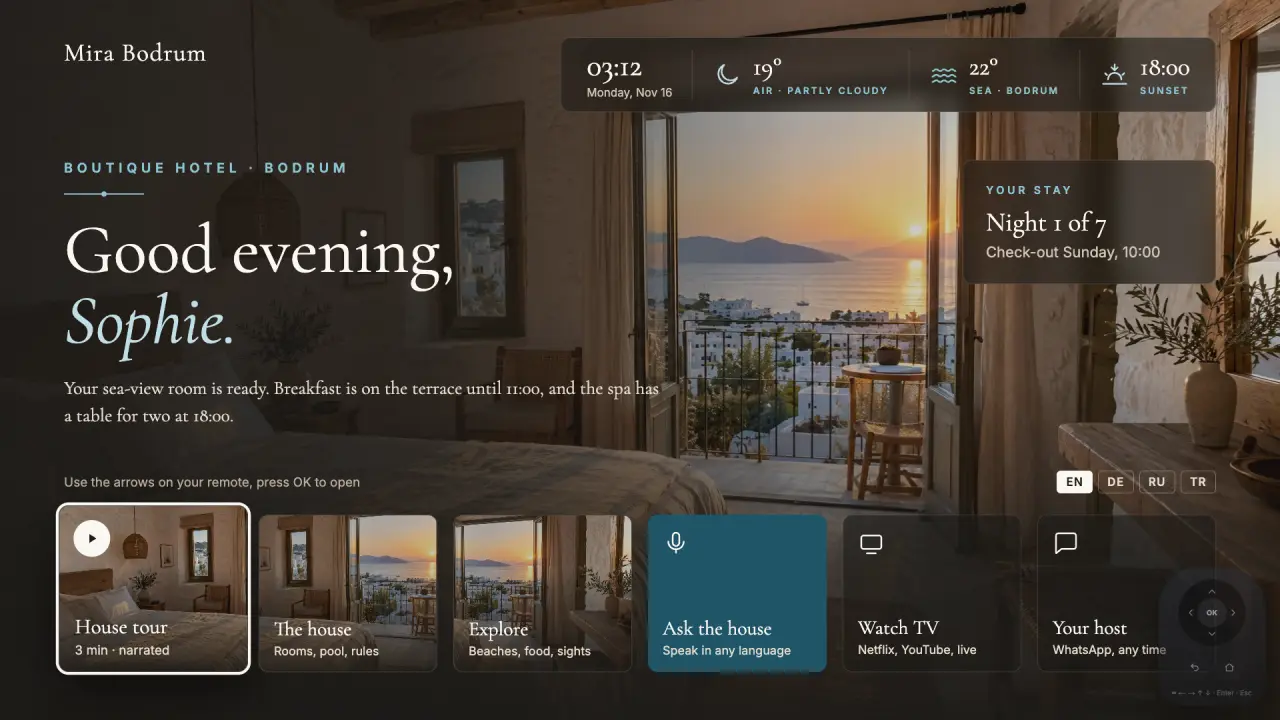
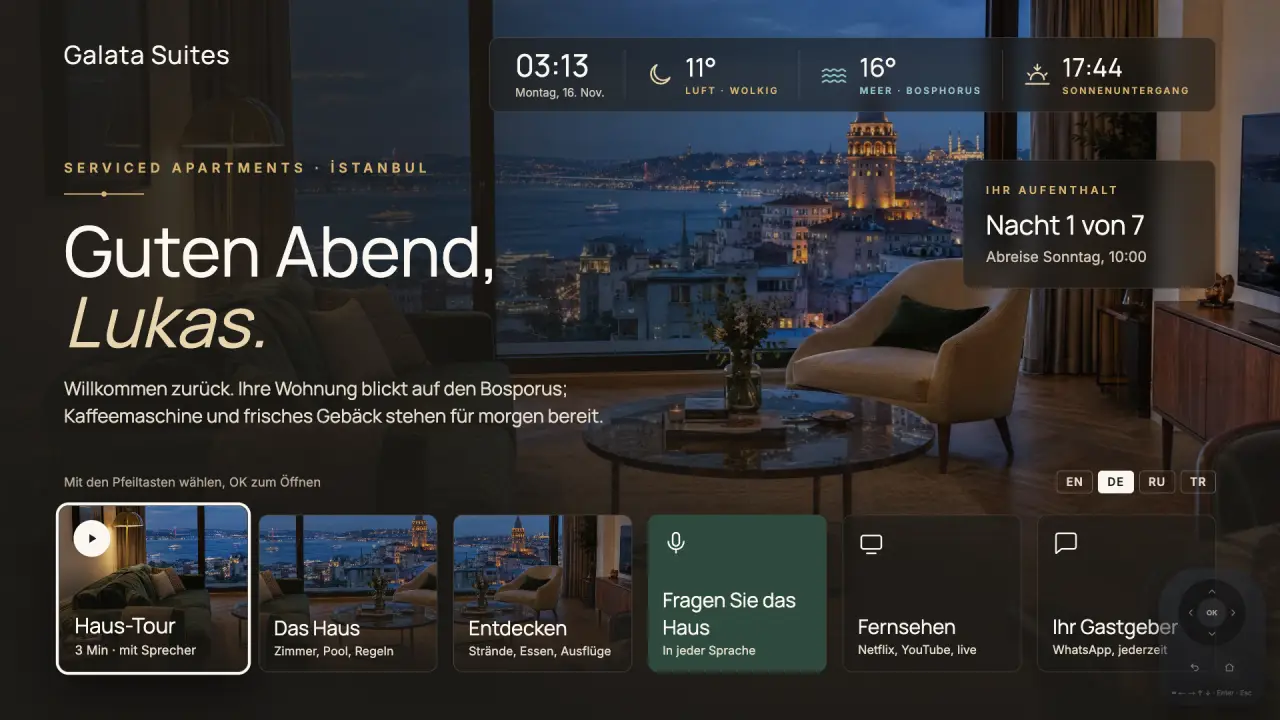
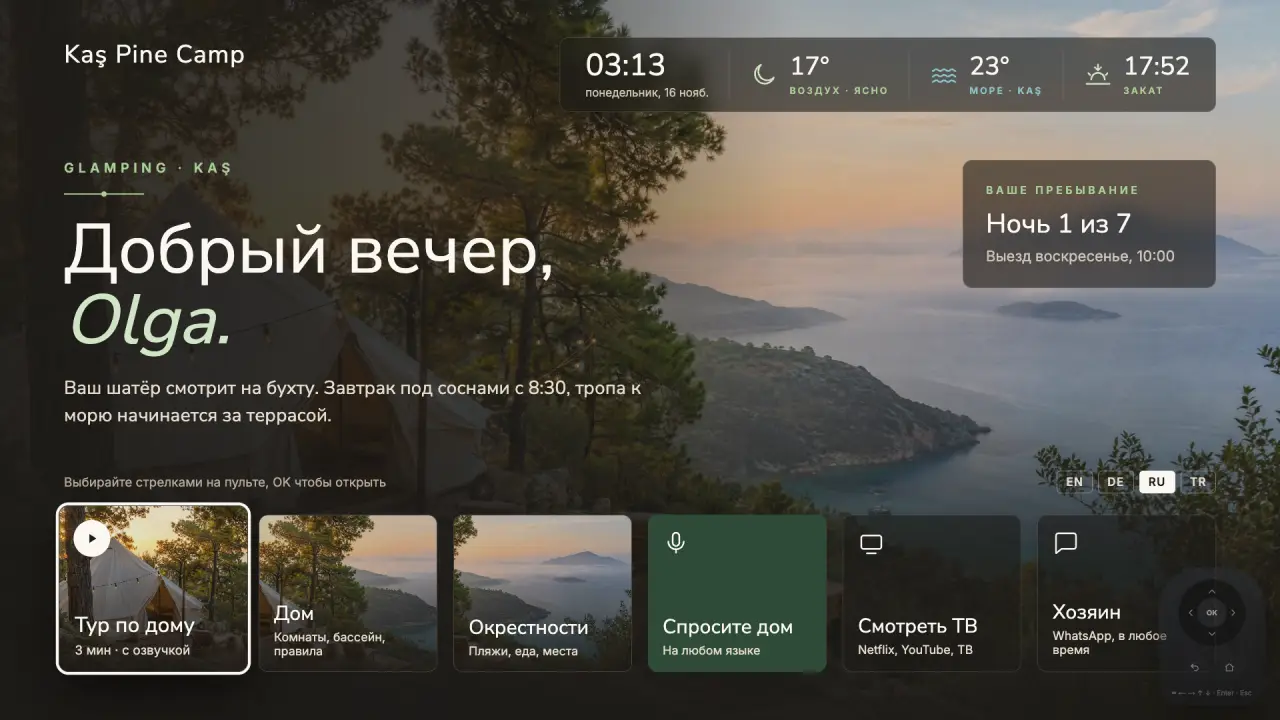
Welcomo's panel is built around writing once in one language, letting AI draft the others, and having you review them. The assistant works in Turkish, English, German and Russian. Review the drafts of anything safety-related yourself.
What guest data does an AI concierge process?
At minimum it processes the guest's question and the answer. Beyond that it depends on the product: some read booking details such as name and dates, some keep conversation history, some pass text to a third-party AI provider. Before you adopt one, ask the vendor in writing what is sent, where it is stored and for how long.
Under the GDPR, the controller is the party that determines the purposes and means of processing personal data, and a processor processes it on the controller's behalf (Article 4). For a short-term rental, that usually makes you, the host, the controller of your guests' data, and the software vendor a processor. That is a reason to prefer vendors that collect minimal data and are open about what they process.
Practical guidance: do not paste door codes or passports into free-text fields, keep the assistant limited to property information, and tell guests an AI is answering. Welcomo describes how it handles data on its privacy page.
- Ask what guest data is processed and whether conversations are stored.
- Ask whether guest messages are sent to a third-party AI provider, and which.
- Ask how a guest's data is deleted after the stay.
- Check that you can review and delete conversations yourself.
Where does the assistant appear: phone, TV or messages?
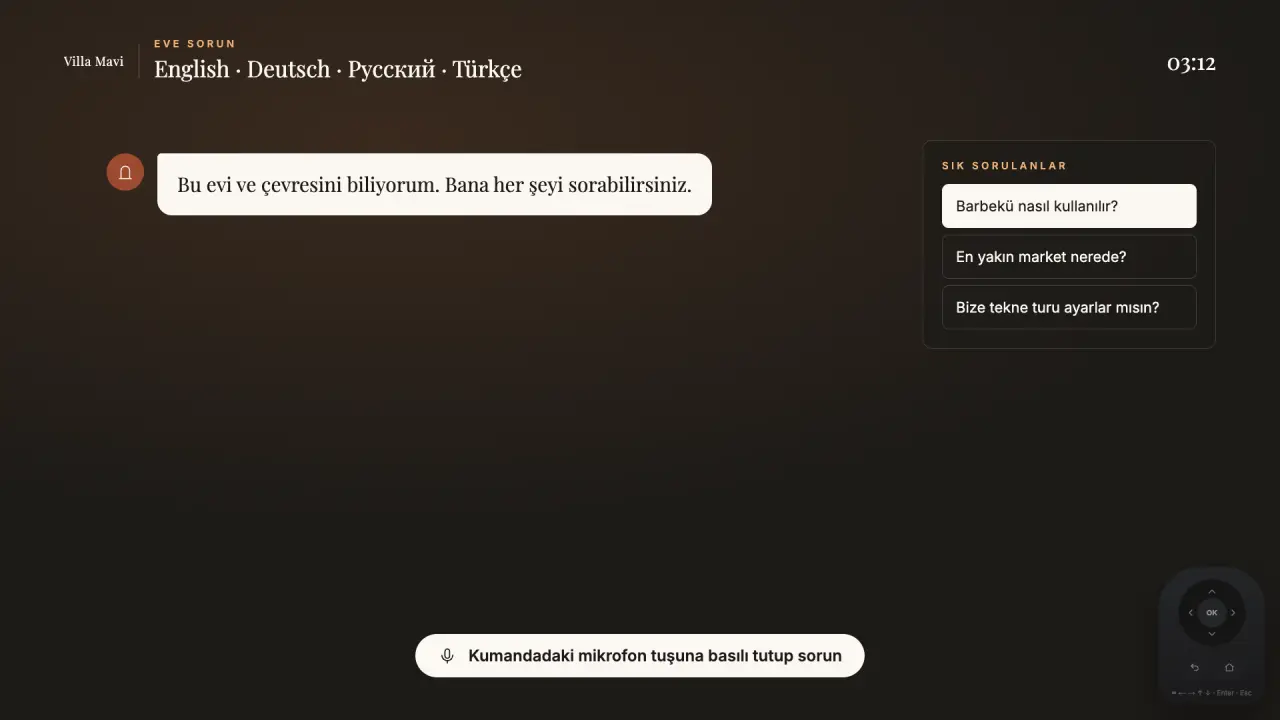
Most assistants live in a guest portal on the phone or inside the messaging inbox. A TV is a useful extra surface because it is already in the room and every guest turns it on. But typing on a TV remote is awkward, so a good TV setup pairs a short on-screen prompt with a QR code that opens the same assistant on the guest's phone.
Welcomo does both: the guest sees the assistant on the TV and can continue on a private phone page that is active from booking to check-out. See the AI concierge page for how it looks in practice.
How do you evaluate an AI concierge? A checklist
Run these steps with any product before you commit, in this order.
- Ask what it answers from. It should be your own information, with a clear way to edit it.
- Ask what happens when it does not know. You want an honest 'I do not have that' and a forward to you.
- Test with ten real questions from past guests, including three trick questions (late check-out, a refund, a place you did not list).
- Check languages: ask the same question in each language your guests use and compare the meaning.
- Read the data terms: what is stored, who processes it, how to delete it.
- Check where guests will see it, and whether they can reach you directly if the assistant fails.
- Check the cost model. Some tools bill per interaction through credits; others include it in a plan.
Frequently asked
Will an AI concierge give guests wrong information?
It can, if it answers from general knowledge or from outdated house information. Limiting answers to your own property information and forwarding unknown questions to you reduces the risk but does not remove it, so test before guests arrive and fix gaps as questions are forwarded.
Does it replace messaging with guests?
No. Vendors themselves describe escalation to a human for judgment calls, refunds and special requests. It handles repetitive questions so you can focus on the ones that need you.
Is an AI concierge allowed under GDPR?
Using one is not prohibited, but you remain responsible for your guests' personal data as controller. Choose a vendor that processes minimal data, explains what it processes, and lets you delete conversations. This is general information, not legal advice.
What does Welcomo's assistant do when it cannot answer?
It answers only from the property's own information. When the information is not there, it forwards the question to the host instead of guessing.
Does the guest need to download an app?
Welcomo's assistant is available on the TV and through a private phone page opened by a QR code, so no app download is needed.
Sources
- Hostaway glossary: AI concierge · retrieved November 16, 2026
- Tourmie help: Guide to AI guest assistant · retrieved November 16, 2026
- AWS: What is Retrieval-Augmented Generation? · retrieved November 16, 2026
- GDPR Article 4 (definitions) · retrieved November 16, 2026